Stella’s childhood in Dungiven
Stella’s Village Childhood
[Stella](entity:character-recall-character-stella-1c92ed1acee3) grows up in a large family in [Dungiven](entity:location-recall-location-3f14f390b066), in a small house without running water or an indoor toilet. She carries water from the street pump and accepts the work as ordinary because the family lives close to the pump.
Books become an early refuge. She waits for the volunteer library to open, reads whatever she can find, and follows unfamiliar words through the family dictionary until curiosity leads her toward knowledge her religious upbringing treats warily.
Stella’s childhood in Dungiven
The House Her Family Lost
[Stella](entity:character-recall-character-stella-1c92ed1acee3)’s family hopes to move into a spacious council house with a bathroom and two lavatories. Her parents pray for it, and her mother secretly places a miraculous medal on the building site as the house is being built.
The four-bedroom home goes instead to a Protestant RUC sergeant. The unfairness becomes one of the experiences that sharpens Stella’s sense of injustice, while it prompts [Gerry](entity:character-recall-character-gerry-2af545ef5299), much later, to condemn the political system that deprived Catholics of power.
Gerry’s adolescence and early career
Gerry’s Early Ambition
[Gerry](entity:character-recall-character-gerry-2af545ef5299) leaves school in the late 1950s unsure what to do. A careers adviser finds him a summer job at an architectural office; the firm offers him an apprenticeship, and he studies architecture at night while learning the work on the job.
He is later recruited by a Catholic practice with commissions for schools and churches. His work ranges from colouring architectural plans to helping with projects shaped by the reforms of the Second Vatican Council, and he begins to build a life around architecture.
The late 1960s
The Dance at Fruithill
[Gerry](entity:character-recall-character-gerry-2af545ef5299) first sees [Stella](entity:character-recall-character-stella-1c92ed1acee3) at a dance at Fruithill, where they discover that neither of them plays tennis. They dance twice, talk on the edge of the crowded floor, and share orange juice on a balcony scented with lilac.
Gerry asks Stella to go out with him. Their attraction begins in conversation and small acts of closeness, a memory he later reconstructs with the tenderness of someone who knows how much of a shared life has become difficult to retrieve.
Soon after Gerry and Stella meet
The Drive to Ballycastle
[Gerry](entity:character-recall-character-gerry-2af545ef5299) takes [Stella](entity:character-recall-character-stella-1c92ed1acee3) north along the east coast to [Ballycastle](entity:location-recall-location-cf6df95168cc). They exchange stories about their families, and Stella tells him about the house her parents had hoped to obtain and the Protestant policeman who received it instead.
They walk along the beach, share ice cream, and talk about the landscape and architecture. At a footbridge, Gerry kisses Stella; after a moment’s hesitation, she returns the kiss. The day becomes a private beginning to their courtship.
Early in Gerry’s career
A Future in Architecture
[Gerry](entity:character-recall-character-gerry-2af545ef5299)’s work takes him to [Derry](entity:location-recall-location-7242cbb9d528), where he contributes to architectural projects and works with designers including Liam McCormick. He and [Stella](entity:character-recall-character-stella-1c92ed1acee3) visit [Grianán of Aileach](entity:location-recall-location-grian-n-of-aileach-329e7b27b157), whose circular form helps Gerry explain the design of [Burt Chapel](entity:location-recall-location-burt-chapel-78c3a49c25ff).
Stella is less interested in the architectural comparison than in the wide view across Donegal, Derry, and Tyrone. Their differing ways of seeing the same landscape become part of their life together: his eye for structures and hers for people, place, and meaning.
The early years of Gerry and Stella’s marriage
Stella Is Shot
While very pregnant and out shopping in [Belfast](entity:location-recall-location-cce514b18f01), [Stella](entity:character-recall-character-stella-1c92ed1acee3) crosses the road and is caught in an ambush. She falls to the pavement, realizes that she is bleeding, and fears that both she and the baby have been shot.
In the ambulance she prays that her child will be spared, promising to devote the rest of her life to God. The bullet passes through her without killing the baby, but the doctors tell her that she will not be able to have more children. The experience becomes a secret burden and the source of a vow she cannot keep.
Immediately after Stella is shot
Gerry Waits at the Hospital
[Gerry](entity:character-recall-character-gerry-2af545ef5299) is brought to the hospital by two members of the [Royal Ulster Constabulary](entity:organization-recall-organization-royal-ulster-con-4c257b8c4402). He experiences their manner and the hospital’s treatment as another form of sectarian exclusion, and waits for news while trying to understand whether [Stella](entity:character-recall-character-stella-1c92ed1acee3) will survive.
A volunteer named [Mavis](entity:character-recall-character-mavis-79465544dfe0) tells him that Stella has left a message: “[All shall be well](entity:expression-recall-expression-all-shall-be-well-02eb5e5321e3).” Gerry visits the newborn Michael in a temporary nursery, touches his cheek, and silently vows to love him for the rest of his life.
During Gerry’s working years in Derry
Gerry’s Office Is Firebombed
[Gerry](entity:character-recall-character-gerry-2af545ef5299)’s architectural office in [Derry](entity:location-recall-location-7242cbb9d528) is firebombed. He returns to find a place of creation savaged: drawings, models, furniture, and materials blackened or reduced to ash.
[Stella](entity:character-recall-character-stella-1c92ed1acee3) responds first with relief that nobody was killed. Gerry is left with the smell of wasted work and the sense that political violence has destroyed not only a building but the accumulated effort and imagination held within it.
During the Troubles
The Bloody Friday Bombings
At a rooftop ceremony in [Belfast](entity:location-recall-location-cce514b18f01), [Gerry](entity:character-recall-character-gerry-2af545ef5299) and another architect are among the people who hear a series of bombs explode across the city. With no warning sirens, those gathered on the roof understand that people below may already be dead or wounded.
Gerry thinks immediately of [Stella](entity:character-recall-character-stella-1c92ed1acee3), who is away in [Dungiven](entity:location-recall-location-3f14f390b066), and of friends who may be working in hospital casualty departments. The bombings deepen his conviction that political violence has made ordinary life hostage to fear and arbitrary loss.
After the years of violence in Northern Ireland
The Family Moves to Scotland
[Gerry](entity:character-recall-character-gerry-2af545ef5299) and [Stella](entity:character-recall-character-stella-1c92ed1acee3) leave [Ireland](entity:location-recall-location-5359e95725af) with their young son, Michael. Their furniture travels below deck on a ferry, while the family watches the wake stream away from [Belfast](entity:location-recall-location-cce514b18f01) and wonders how they will be received in [Scotland](entity:location-recall-location-783abb4abcea).
The crossing takes place amid the noise and tension of the Twelfth celebrations. Gerry remembers the sectarian violence that has driven their lives and fears that hatred will simply be carried forward; the move begins a new home without erasing the old country’s wounds.
During the family’s years in Glasgow
Stella’s Life of Care
In [Glasgow](entity:location-recall-location-a7ae7624794d), [Stella](entity:character-recall-character-stella-1c92ed1acee3) raises Michael, teaches, organizes household life, and takes responsibility for an expanding circle of community duties. She later becomes a Eucharistic minister and continues to pray, though [Gerry](entity:character-recall-character-gerry-2af545ef5299) does not share her faith.
She also keeps the practical machinery of their shared life moving: meals, travel plans, family contact, and care for their home. Gerry admires her knowledge and competence, even as he often takes that labor for granted.
Over the years before retirement
Gerry’s Drinking Takes Hold
[Gerry](entity:character-recall-character-gerry-2af545ef5299) increasingly relies on whiskey, describing it as the Traveller’s Friend because it helps him sleep and loosens his thoughts. He tells himself that small measures, diluted drinks, and holiday drinking do not count, while often losing track of how much he has consumed.
The drinking becomes a private system of concealment: he hides volume from [Stella](entity:character-recall-character-stella-1c92ed1acee3), plans supplies, and invents explanations for suspicious sounds or missing bottles. His dependence erodes his memory and health, while Stella bears the loneliness and uncertainty created by his self-deception.
In the years before the Amsterdam trip
Stella’s Old Vow Returns
[Stella](entity:character-recall-character-stella-1c92ed1acee3) continues to think about the vow she made when she was shot while pregnant. She has never told [Gerry](entity:character-recall-character-gerry-2af545ef5299) or anyone else the full story, but the promise remains alive whenever she prays or considers how to use the time left to her.
Her search for a more purposeful religious life grows alongside her dissatisfaction with Gerry’s drinking and the distance between their beliefs. The old emergency bargain gradually becomes a question about vocation, obligation, and whether she can still make a useful life of her own.
A few weeks before the Amsterdam trip
A Christmas Revelation
At [Christmas](entity:time-recall-time-christmas-a573265d0167) midnight Mass, [Gerry](entity:character-recall-character-gerry-2af545ef5299) accompanies [Stella](entity:character-recall-character-stella-1c92ed1acee3) and discovers that she serves as a Eucharistic minister. He watches her distribute communion and sees her as both familiar and strangely unknown; afterward, she is overcome by emotion during the service.
On the walk home, Gerry tells her he is proud of her, though he does not believe what she believes. Stella asks him not to turn the moment into an argument. The exchange exposes a tenderness that persists alongside his habitual mockery of her faith.
Christmas, shortly before the trip
The Amsterdam Tickets
[Stella](entity:character-recall-character-stella-1c92ed1acee3) gives [Gerry](entity:character-recall-character-gerry-2af545ef5299) tickets for a midwinter trip to [Amsterdam](entity:location-recall-location-amsterdam-68440c77c10d), explaining that she used a travel agent because she wanted the booking to be certain. He responds with a practical quibble about the cost, but the trip is already arranged.
Gerry gives Stella a pair of eternity earrings for [Christmas](entity:time-recall-time-christmas-a573265d0167), remembering how pleased she had been to have her ears pierced. The present later becomes entangled with her attempt to make a gesture of solidarity at the [Anne Frank House](entity:location-recall-location-e14df9f012b6).
The night before the flight
The Night Before Departure
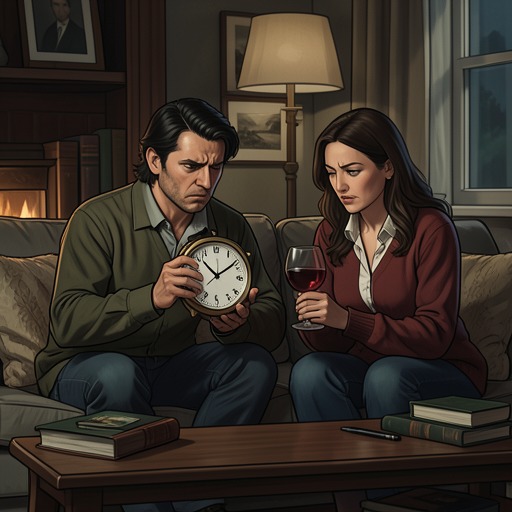
At home, [Stella](entity:character-recall-character-stella-1c92ed1acee3) prepares for bed while resenting the routines of creams, cotton wool, and the household duties waiting for her in the morning. [Gerry](entity:character-recall-character-gerry-2af545ef5299) drinks whiskey on the sofa and listens to music through headphones, turning the volume so high that the speakers blast through the flat.
Stella confronts him, warning that he will damage his hearing and drive her away. Gerry apologizes, then pours another drink. His private ritual and her exhaustion establish the imbalance they carry into the holiday.
Before dawn on departure day
Gerry Sees the Sparklers
[Gerry](entity:character-recall-character-gerry-2af545ef5299) wakes with flashes of light in his vision and worries that they may signal a stroke. He recalls an optician dismissing them as common at his age, then blames the cold, the previous night’s drinking, and his own declining health in turn.
Moving quietly through the flat, he discovers that [Stella](entity:character-recall-character-stella-1c92ed1acee3) has left a religious image open on the computer. The image of a statue in a green enclosure will later help her locate the [Begijnhof](entity:location-recall-location-begijnhof-b7953ef9de74), where she hopes to investigate a possible religious community.
Departure morning
Packing and the Late Taxi
As they wait for the taxi, [Stella](entity:character-recall-character-stella-1c92ed1acee3) checks passports, medication, tickets, and the contents of her handbag, while [Gerry](entity:character-recall-character-gerry-2af545ef5299) complains about the delay and her Filofax. Their familiar teasing covers a sharper difference: Stella anticipates practical needs, and Gerry resents the attention she gives them.
Gerry jokes about the taxi company’s promise that the car is on its way, and Stella vacuums a last patch of carpet before leaving. The small rituals show how deeply she has become the household organizer, even as both insist they are going on holiday together.
Departure day
The Airport Departure
The taxi drops them far from the terminal because of security rules following an earlier car bombing. [Gerry](entity:character-recall-character-gerry-2af545ef5299) questions the airport’s bollards, and the couple struggle through queues and security, where his shampoo and conditioner are confiscated.
At duty-free Gerry buys whiskey despite [Stella](entity:character-recall-character-stella-1c92ed1acee3)’s warning that it will be cheaper in [Amsterdam](entity:location-recall-location-amsterdam-68440c77c10d). He also forgets her Werther’s sweets, then secretly buys them and presents them before take-off. Their familiar bickering carries both affection and a pattern of small concealments.
During the flight’s airport wait
A Child at the Hand Dryer
In the airport lavatory, a small boy is startled when a powerful hand dryer roars over his head. [Gerry](entity:character-recall-character-gerry-2af545ef5299) crouches to comfort him until the child turns back toward his father, and Gerry tells the man that he has a grandson of similar age.
The encounter briefly brings out Gerry’s capacity for care. He reflects that architects and designers should take responsibility for objects that frighten or endanger people, a humane instinct that contrasts with the self-absorption of his drinking.
The flight to Amsterdam
A Nervous Flight
[Stella](entity:character-recall-character-stella-1c92ed1acee3) grips the armrest during take-off and explains that pressure-point wristbands help prevent nausea. [Gerry](entity:character-recall-character-gerry-2af545ef5299) dismisses the device and suggests the rosary instead, prompting her to remember saying it on the way to dances in 1950s [Ireland](entity:location-recall-location-5359e95725af).
She tells him that she has personal concerns to pursue in [Amsterdam](entity:location-recall-location-amsterdam-68440c77c10d) and does not assume they must do everything together. Gerry calls this storyboarding; Stella likes the word, even though neither yet says plainly what she is planning.
The first day of the trip
Arrival in Amsterdam
The couple arrive in grey, rainy [Amsterdam](entity:location-recall-location-amsterdam-68440c77c10d) and travel by train to the city. [Stella](entity:character-recall-character-stella-1c92ed1acee3) is moved by the idea of Europe as shared land, while [Gerry](entity:character-recall-character-gerry-2af545ef5299) wants to get to their destination before being carried away by the thought of other cities.
They take a taxi to [Hotel Theo](entity:location-recall-location-hotel-theo-8a8a969db885), settle into their room, and negotiate the familiar routines of keys, luggage, and service. Stella draws back the curtains; Gerry jokes about the hotel’s welcome message, already turning the holiday into a stage for their old exchanges.
The first evening in Amsterdam
Their First Evening Out
After a long nap, [Stella](entity:character-recall-character-stella-1c92ed1acee3) and [Gerry](entity:character-recall-character-gerry-2af545ef5299) go out to eat. Stella is amused by the handsome waiter, while Gerry finishes the wine and later complains about the token Irish decor in a nearby pub.
When the musicians begin playing IRA songs, Stella wants to leave. Gerry is angry at the assumption that Irish identity means support for violence, and he drains his whiskey. Their conversation turns toward refugees, suicide, faith, and the limits of enjoying a holiday while others suffer.
The first morning in Amsterdam
Stella Finds the Enclosed Garden
[Stella](entity:character-recall-character-stella-1c92ed1acee3) wakes before [Gerry](entity:character-recall-character-gerry-2af545ef5299) and walks alone through the city, guided by her [Amsterdam](entity:location-recall-location-amsterdam-68440c77c10d) guidebook. She finds a passage leading into the [Begijnhof](entity:location-recall-location-begijnhof-b7953ef9de74), a sheltered enclosure of old houses, trees, and a church, and recognizes the religious image she saw on the computer at home.
The garden feels like a sanctuary and a possible beginning. Stella studies its history and waits near the office, quietly rehearsing how to ask about a life devoted to prayer and good works.
The first night in Amsterdam
Gerry’s Hospital Memory
Drinking alone in the hotel room, [Gerry](entity:character-recall-character-gerry-2af545ef5299) is pulled into a memory of being summoned from work by two members of the [Royal Ulster Constabulary](entity:organization-recall-organization-royal-ulster-con-4c257b8c4402). They tell him [Stella](entity:character-recall-character-stella-1c92ed1acee3) has been in an accident and take him to the [Belfast](entity:location-recall-location-cce514b18f01) hospital, where their manner makes him feel marked as Catholic.
In the present, he wakes from the memory beside Stella and tries to hide how much he has been drinking. His private fear of the past and his evasions in the present become increasingly difficult to separate.
The first full morning in Amsterdam
A Morning Apart
[Gerry](entity:character-recall-character-gerry-2af545ef5299) wakes late, discovers [Stella](entity:character-recall-character-stella-1c92ed1acee3) is gone, and searches the hotel before eating breakfast alone. Her absence unsettles him, and an ordinary meal becomes a reminder of the hospital waiting room where he once feared she would die.
Stella, meanwhile, shops for small presents for Michael and his family in [Canada](entity:location-recall-location-ed6a2f8d0910). Their separate mornings reveal how much of the trip Stella has already claimed for herself, even as Gerry worries about where she has gone.
Later on the first morning
The Begijnhof Reunion
[Gerry](entity:character-recall-character-gerry-2af545ef5299) spots [Stella](entity:character-recall-character-stella-1c92ed1acee3) across a square and follows her, briefly afraid that she may be meeting someone she knows. He whistles to get her attention, and she turns toward him as instinctively as a bird recognizing its own chick.
Over coffee, Stella explains her morning walk and the [Begijnhof](entity:location-recall-location-begijnhof-b7953ef9de74). Gerry asks about the man he saw speaking with her; she says he was a patient stranger in a queue. Their reunion is affectionate, but Gerry’s questions reveal the insecurity beneath his joking manner.
The first day in Amsterdam
The Hidden Catholic Church
[Stella](entity:character-recall-character-stella-1c92ed1acee3) leads [Gerry](entity:character-recall-character-gerry-2af545ef5299) through the passage into the [Begijnhof](entity:location-recall-location-begijnhof-b7953ef9de74) and shows him its enclosed garden, statues, and concealed Catholic church. She explains that Catholics once worshipped in houses because public Mass was prohibited in [Amsterdam](entity:location-recall-location-amsterdam-68440c77c10d).
Inside, they read the story of a communion wafer said to have survived fire after a sick man vomited it up. Gerry makes irreverent jokes, while Stella treats the account as part of the place’s layered history and spiritual meaning.
The first day in Amsterdam
The Prayer Book Entries
At the back of the church, [Gerry](entity:character-recall-character-gerry-2af545ef5299) finds a multilingual [Book for your Prayers](entity:object-recall-object-book-for-your-prayers-19f0459c0446). One entry, written by a distressed pregnant woman, asks God to reunite her with the child’s father and questions whether God exists when nothing changes.
[Stella](entity:character-recall-character-stella-1c92ed1acee3) reads the entry with compassion, touching the page as if comforting its author. The discovery makes her think about suffering beyond her own life and strengthens her wish to do something useful for others.
The first day in Amsterdam
A Memory of Their Courtship
As [Stella](entity:character-recall-character-stella-1c92ed1acee3) explores the garden, she remembers the beginning of her relationship with [Gerry](entity:character-recall-character-gerry-2af545ef5299): their drive to [Ballycastle](entity:location-recall-location-cf6df95168cc), their conversation about family and politics, and their first kiss on the footbridge. She recalls how his talk about architecture once made a world she had barely noticed feel alive.
The memory contrasts the attentive young man with the husband whose drinking now occupies so much of her attention. It is not a simple rejection of their past; the recollection makes the distance between then and now more painful.
The first day in Amsterdam
The Beguine History
[Gerry](entity:character-recall-character-gerry-2af545ef5299) and [Stella](entity:character-recall-character-stella-1c92ed1acee3) enter the church and learn that it once served Catholics worshipping in secret. They also browse the prayer book, where one woman’s pleas for her partner and unborn child give their sightseeing a more intimate human dimension.
Stella explains that the [Beguines](entity:organization-recall-organization-beguines-a68cd677499d) were women who lived religious lives without permanent vows, retaining the ability to return to ordinary life or marry. She tells Gerry that she has made an appointment to ask about the community, but he still does not understand what she hopes to find.
The first afternoon in Amsterdam
Gerry’s Private Drinking
While [Stella](entity:character-recall-character-stella-1c92ed1acee3) sleeps, [Gerry](entity:character-recall-character-gerry-2af545ef5299) drinks whiskey and remembers friends warning him that solitary drinking removes the brakes that other people provide. He tries to regard his drinking as a means of feeling more deeply, not as a form of harm.
News images of conflict and memories of violence in [Ireland](entity:location-recall-location-5359e95725af) pull him toward the firebombing of his [Derry](entity:location-recall-location-7242cbb9d528) office and the destruction of Bombay Street. He imagines his lost architectural work burning again, exposing the futility of creating in a world repeatedly set on destruction.
The first afternoon in Amsterdam
The Jewish Bride
At the [Rijksmuseum](entity:location-recall-location-70e90bfb6c1c), [Gerry](entity:character-recall-character-gerry-2af545ef5299) moves rapidly through galleries while [Stella](entity:character-recall-character-stella-1c92ed1acee3)’s feet ache. They stop together before [The Jewish Bride](entity:object-recall-object-dfe63a6b289d), where Stella sees tenderness in the groom’s touch and uncertainty in the bride’s guarded posture.
Their discussion turns the painting into a question about consent and intimacy. Stella studies the woman’s hand protecting her stomach, while Gerry focuses on the paint and the scale of the hands; they briefly share an attentive way of looking.
After the Rijksmuseum visit
Stella Explains Her Search
Over coffee, [Stella](entity:character-recall-character-stella-1c92ed1acee3) tells [Gerry](entity:character-recall-character-gerry-2af545ef5299) that she is tired of their life as it is and wants to live more devoutly. She has been considering whether a religious community like the Beguinage might offer a way to pray, do charitable work, and live independently.
Gerry asks what this would mean for their marriage. Stella says that they may be in different places, and the answer makes clear that her inquiry is not merely a tourist’s curiosity. Gerry is frightened by how little he understands about what she wants.
The first evening after the museum
The Secret Half-Bottles
[Gerry](entity:character-recall-character-gerry-2af545ef5299) realizes that his whiskey supply is running low and that he failed to plan for the next day. After [Stella](entity:character-recall-character-stella-1c92ed1acee3) falls asleep, he secretly buys two small bottles at a supermarket, using margarine to clean paint from his stained hand as cover for leaving the restaurant.
He conceals the bottles in his clothing and later pours their contents into the larger bottle. The elaborate operation turns his drinking into a furtive second itinerary, and his planning for alcohol contrasts sharply with Stella’s search for a different life.
The first evening after the museum
The Marriage Conversation
At dinner, [Stella](entity:character-recall-character-stella-1c92ed1acee3) tells [Gerry](entity:character-recall-character-gerry-2af545ef5299) that she feels aimless now that her work of raising a family is over. She wants to use the time left to her for something more valuable, and she has arranged to speak with the spiritual director at the [Begijnhof](entity:location-recall-location-begijnhof-b7953ef9de74).
She explains that she is exploring a religious community rather than a convent, but Gerry struggles to grasp what she means. When he asks whether he is part of her storyboard, Stella answers, “Not really.” The marriage’s underlying crisis is finally spoken aloud.
The night before the Anne Frank House visit
The Night of Concealment
While [Stella](entity:character-recall-character-stella-1c92ed1acee3) sleeps, [Gerry](entity:character-recall-character-gerry-2af545ef5299) drinks from the hidden supply and tries to reason away the implications of her words. He worries that she may no longer include him in her future, but he cannot face the prospect without reaching again for whiskey.
He carries empty bottles through the hotel corridor to dispose of them, loses his way, and eventually finds their room. The episode leaves him more disoriented and deepens the pattern of secrecy that is damaging their trust.
The following morning
The Anne Frank House
[Gerry](entity:character-recall-character-gerry-2af545ef5299) and [Stella](entity:character-recall-character-stella-1c92ed1acee3) visit the [Anne Frank House](entity:location-recall-location-e14df9f012b6), moving through the hidden rooms in near silence. Gerry notices the children’s growth marks on the wallpaper; Stella recognizes the practice from measuring Michael as he grew.
The exhibits connect a public catastrophe to ordinary family life. Stella is moved by Anne’s writing, by the objects left as tokens, and by the human traces of a young life cut short. Gerry sees the weight of the visit but cannot fully anticipate what she will do.
During the Anne Frank House visit
Stella Leaves an Earring
Alone in a room at the [Anne Frank House](entity:location-recall-location-e14df9f012b6), [Stella](entity:character-recall-character-stella-1c92ed1acee3) sees small objects visitors have left as tokens of remembrance. Overcome by the history and the suffering of the Frank family, she removes one of the eternity earrings [Gerry](entity:character-recall-character-gerry-2af545ef5299) gave her and places it among the objects.
She frames the act as a gesture of solidarity with Anne Frank, a young woman whose life was destroyed by persecution. The offering gives Stella a moment of spiritual intensity, but she soon doubts whether a stranger has any right to make such a claim of kinship.
Immediately after the Anne Frank House visit
The Earring Misunderstanding
[Stella](entity:character-recall-character-stella-1c92ed1acee3) returns to retrieve her earring, ashamed that she may have treated the memorial objects as an opportunity to feel virtuous. An elderly Jewish visitor sees her take it and appears to believe she is stealing from the memorial.
Stella cannot explain herself and flees in distress. Outside, she tells [Gerry](entity:character-recall-character-gerry-2af545ef5299) that the man’s accusation has made her feel profoundly ashamed. Her attempt at solidarity has turned into a painful lesson about the limits of intention and the vulnerability of gestures made in another person’s place.
After leaving the Anne Frank House
The Earrings Go Into the Canal
Walking beside a canal, [Stella](entity:character-recall-character-stella-1c92ed1acee3) worries that the earring will forever recall her humiliation. [Gerry](entity:character-recall-character-gerry-2af545ef5299) tells her she can do what she likes with the gift; she drops first one earring and then the other into the dark water.
The act brings no clean relief. Stella immediately thinks she might have sold them and given the money to charity, while Gerry tries to comfort her with a joke about loving her more than Coco Pops. Their exchange briefly restores their closeness without resolving the deeper problems between them.
Later that day
The Gardener and the Flower
In a winter park, [Stella](entity:character-recall-character-stella-1c92ed1acee3) and [Gerry](entity:character-recall-character-gerry-2af545ef5299) talk about whether people are good at heart, the care built into a child’s playground, and the mother who adjusts a ball game to help her daughter succeed. Stella sees teaching in the mother’s gentle guidance; Gerry jokes that she is cheating.
Stella describes relationships through the image of a gardener and a flower: one person does the daily work, while the other gets to display. She lists the household labor she carries and asks how the gardener might end a relationship. Gerry recognizes the image but does not yet answer the question beneath it.
Later on the second day
The Van Gogh Memorial
The couple encounter flowers and messages left in memory of a murdered filmmaker named Van Gogh. [Stella](entity:character-recall-character-stella-1c92ed1acee3) reads the notes and grows visibly shaken by the violence and the public acts of mourning.
[Gerry](entity:character-recall-character-gerry-2af545ef5299) takes her back to the hotel when she asks for a rest. Her reaction shows how easily the trip’s encounters with suffering reach her, and how much emotional weight she is carrying beneath her practical composure.
While resting on the second day
Stella’s Memory of the Hunterian
Unable to sleep, [Stella](entity:character-recall-character-stella-1c92ed1acee3) remembers visiting the [Hunterian Museum](entity:location-recall-location-hunterian-museum-c07445fef42a) with Michael when he was a small child. There she saw a life-size anatomical image of a woman whose body had been opened to show a baby in the womb.
The display overwhelms her because she recognizes her own pregnancy in the exposed body and resents that the unnamed woman has been turned into an object of knowledge. She shields Michael from the image and prays for the woman and child, carrying the memory as part of her own history of bodily vulnerability.
During the second day
Gerry’s Career and Regrets
Alone in an Irish pub, [Gerry](entity:character-recall-character-gerry-2af545ef5299) remembers his path from apprentice to university teacher and the buildings that shaped his career. He recalls great architects and wonders whether drinking helped cause his failure to reach the highest level, or whether disappointment led him to drink.
He also remembers that he and [Stella](entity:character-recall-character-stella-1c92ed1acee3) once seemed congruent, alike in a way that now feels lost. The reflection gives his professional unease a personal counterpart: he is unsure not only what he made of his career but what he has made of their marriage.
The second evening in Amsterdam
A Return to the Red-Light District
[Stella](entity:character-recall-character-stella-1c92ed1acee3) suggests that they visit the [Amsterdam Red Light District](entity:location-recall-location-622a09d88b7e). They look through the narrow streets and windowed rooms, where the women’s working lives seem to Stella less glamorous than exposed and lonely.
In a crowded bar, [Gerry](entity:character-recall-character-gerry-2af545ef5299) tries jenever and becomes distracted by drinking, while Stella struggles to hear an American man who approaches her. They leave the noise and continue through the district, where their attention shifts from the women in the windows to two quiet police horses.
The second evening in Amsterdam
The Police Horses
In a side lane, [Stella](entity:character-recall-character-stella-1c92ed1acee3) is delighted by two police horses standing in the cold. She touches one gently and studies its veins, warmth, and scent; [Gerry](entity:character-recall-character-gerry-2af545ef5299) warns her not to stand behind it.
The encounter gives Stella a gentler image of the red-light district than the display in the windows. Later she says the horses have stirred her desire, and the couple make love. Their physical closeness briefly seems to recover an older intimacy, though Stella wonders whether this may have been their last time.
Sunday morning
A Sunday Mass
[Stella](entity:character-recall-character-stella-1c92ed1acee3) prepares for Mass while [Gerry](entity:character-recall-character-gerry-2af545ef5299) questions the claims made by hair products and the women who sell them. He asks whether she wants him to accompany her; she says she does not.
At the hotel desk, she asks about the concealed Catholic church in the red-light district, but learns it is now a museum. Gerry jokes that religion belongs in museums, while Stella makes the effort to find the nearest church and goes alone.
During Stella’s Sunday Mass
Gerry Buys Spring Bulbs
While [Stella](entity:character-recall-character-stella-1c92ed1acee3) attends Mass, [Gerry](entity:character-recall-character-gerry-2af545ef5299) spends the hour walking through [Amsterdam](entity:location-recall-location-amsterdam-68440c77c10d). He buys a recording of Seven Last Words from the Cross and finds a flower market full of bulbs waiting for spring.
Knowing Stella loves her small garden at home, he chooses a bag of mixed bulbs as a gift. The purchase is a modest attempt at care, a gesture that he can make without yet addressing the larger hurt his drinking causes.
Sunday morning at the Begijnhof church
The American Woman’s Prayer
When [Gerry](entity:character-recall-character-gerry-2af545ef5299) joins [Stella](entity:character-recall-character-stella-1c92ed1acee3) in the church after Mass, she shows him a new entry in the prayer book. The American woman who had once written in despair now thanks God because the father of her child has returned, though she knows the reconciliation may not last.
Stella is delighted by the change and sees it as a small human hope emerging from the earlier plea. Gerry reads the entry with her, sharing a moment in which their differing beliefs do not prevent them from recognizing another person’s joy.
Monday morning
Stella Meets Kathleen
[Stella](entity:character-recall-character-stella-1c92ed1acee3) returns to the [Begijnhof](entity:location-recall-location-begijnhof-b7953ef9de74) office for her appointment, but the woman she hoped to see is delayed. A resident, [Kathleen Walsh](entity:character-recall-character-kathleen-walsh-97feb7caa207), notices her difficulty and offers to explain the place over tea.
Kathleen invites Stella to her steep, compact apartment and describes the history of the [Beguines](entity:organization-recall-organization-beguines-a68cd677499d), women who once lived in community without permanent vows. Stella listens closely, hoping that the Begijnhof might offer a model for a religious life she can still enter.
Monday morning
The Modern Begijnhof
Kathleen explains that the religious order has disappeared, though the [Begijnhof](entity:location-recall-location-begijnhof-b7953ef9de74) still has apartments occupied by independent women. She herself once belonged to the Sisters of Mercy and now teaches while maintaining her faith in a different setting.
The community’s housing is not a functioning sisterhood: places are scarce, the waiting list can stretch for years, and residents must meet age and financial conditions. [Stella](entity:character-recall-character-stella-1c92ed1acee3) realizes that the spiritual refuge she imagined no longer exists in the form she hoped for.
Monday morning
Stella Tells Kathleen the Truth
Before leaving Kathleen, [Stella](entity:character-recall-character-stella-1c92ed1acee3) confesses that she was shot in [Belfast](entity:location-recall-location-cce514b18f01) while pregnant. She tells Kathleen about the promise she made in the ambulance: if God spared the baby, she would devote the rest of her life to Him.
Stella has never shared the vow with [Gerry](entity:character-recall-character-gerry-2af545ef5299) or anyone else. Michael survived, but she feels she failed to fulfil the promise, and her search for a religious community has become an attempt to repay a debt she has carried for decades. Kathleen comforts her, but the confession cannot restore the opportunity Stella came seeking.
Monday, after Stella’s meeting
The Begijnhof Dream Closes
[Stella](entity:character-recall-character-stella-1c92ed1acee3) meets [Astrid Hoogendorp](entity:character-recall-character-astrid-hoogendorp-0ed737629681) and learns that the [Begijnhof](entity:location-recall-location-begijnhof-b7953ef9de74)’s remaining community is a housing arrangement rather than an active religious order. Its age limit excludes her, and the waiting list makes even a future place unlikely.
She returns to the airport feeling that her plan has collapsed. The failure forces her to consider a different sanctuary: living apart from [Gerry](entity:character-recall-character-gerry-2af545ef5299), even if she cannot join a religious community. Her faith remains central, but she must now decide how to practise it within the life she actually has.
Monday evening
The Flight Is Grounded
Snow intensifies as [Gerry](entity:character-recall-character-gerry-2af545ef5299) and [Stella](entity:character-recall-character-stella-1c92ed1acee3) reach [Schiphol Airport](entity:location-recall-location-5a01e1b0b64c). Gerry wants a drink, while Stella remains withdrawn after her meeting; he continues to drink from the supply he has carried with him.
The storm and airport announcements bring growing uncertainty, then all flights are cancelled for the night. The couple are stranded among crowds of sleeping passengers, surrounded by delays, litter, and exhaustion. Their practical inconvenience becomes the setting for a decision neither can put off.
Monday night at Schiphol Airport
Stella Says She Will Leave
As [Gerry](entity:character-recall-character-gerry-2af545ef5299) drinks the remaining whiskey, [Stella](entity:character-recall-character-stella-1c92ed1acee3) tells him that she wants to leave him but does not know how to go about it. Gerry does not deny that she may have reason to leave; he wanders away with the empty bottle, too drunk to answer fully.
Stella concludes that she will sell the flat and find a place of her own. Gerry returns and asks what she means, and she begins to spell out the future she has already been considering. The airport becomes the first place where she states plainly that their marriage may end.
During the airport night
Stella’s Belfast Flashback
Alone in the women’s toilet, [Stella](entity:character-recall-character-stella-1c92ed1acee3) cries and relives the [Begijnhof](entity:location-recall-location-begijnhof-b7953ef9de74) rejection and the collapse of her hopes. Her thoughts turn to her age, the lost religious community, and the possibility of separating from [Gerry](entity:character-recall-character-gerry-2af545ef5299) and living independently.
The memory then carries her back to the day she was shot: a hot summer, shopping, the sound of gunfire, blood on the pavement, and the fear that her unborn child was dying. In the airport, the old trauma returns with physical force, and Stella must struggle to distinguish past danger from present exhaustion.
Overnight at Schiphol Airport
The Night Under Snow
The airport remains closed, and [Stella](entity:character-recall-character-stella-1c92ed1acee3) wanders between crowded waiting areas while [Gerry](entity:character-recall-character-gerry-2af545ef5299) sleeps on the floor near their bags. She considers whether a life with Gerry could continue if he stopped drinking, but knows she cannot keep organizing his life for him.
In a quieter gate area, Stella dozes and remembers childhood, family, and the years of work she has carried. She reflects on the “sparrow in the hall” as an image of a brief life passing through warmth and shelter, and feels the whole holiday has become a cul-de-sac.
Early Tuesday morning at Schiphol Airport
Gerry Searches for Stella
[Gerry](entity:character-recall-character-gerry-2af545ef5299) wakes and cannot find [Stella](entity:character-recall-character-stella-1c92ed1acee3), then searches through the terminal before discovering her in a quiet area. She has not left, but the fear of losing her makes him see how close their separation has come.
Stella has also been shaken by a vivid return to the day of the shooting. Gerry comforts her, urges her to focus on the airport rather than the past, and holds her until her trembling eases. For the first time in the crisis, he offers sustained, attentive care.
Tuesday morning at Schiphol Airport
Gerry Names His Drinking
After [Stella](entity:character-recall-character-stella-1c92ed1acee3) steadies, she confronts [Gerry](entity:character-recall-character-gerry-2af545ef5299) about his drinking and the deception that surrounds it. She tells him he is an alcoholic, that she has seen how much he drinks, and that nobody can make the necessary change except him.
Gerry says he will stop and admits that he hates himself when he drinks. Stella warns him that she has heard promises before, but this time the scale of the crisis makes the promise harder to evade. He acknowledges that if he fails, he will seek help and try again.
Tuesday morning at Schiphol Airport
Faith Becomes the Argument
[Gerry](entity:character-recall-character-gerry-2af545ef5299) apologizes for his conduct and says he admires and loves [Stella](entity:character-recall-character-stella-1c92ed1acee3). She answers that his drinking has made her lonely, and challenges him about the mockery with which he treats her faith.
Gerry insists that he is debating what he sees as a deception; Stella says Mass is the most precious part of her life and the structure that helps her get through it. Their disagreement reveals that reconciliation will require more than sobriety: he must respect the practice that gives her life meaning.
Tuesday morning at Schiphol Airport
A Conditional Second Chance
[Stella](entity:character-recall-character-stella-1c92ed1acee3) tells [Gerry](entity:character-recall-character-gerry-2af545ef5299) that, if he is serious about quitting, the flat may not have to be sold. She does not withdraw her warning or pretend that the marriage is repaired; instead, she makes continued life together conditional on real change.
Gerry repeats that he will stop drinking, and Stella says she will help him learn to love himself again. She asks him to cherish the time they have left and to show care in ordinary ways, including bringing her flowers. Their reconciliation is provisional, grounded in action rather than a promise alone.
Tuesday morning at Schiphol Airport
The Bulbs for the Gardener
[Gerry](entity:character-recall-character-gerry-2af545ef5299) gives [Stella](entity:character-recall-character-stella-1c92ed1acee3) the bag of mixed bulbs he bought while she was at Mass. He admits they may include tulips, but does not know exactly what will grow; Stella says she will plant them in autumn and see what comes up next year.
The gift answers her request for flowers without pretending to solve the marriage. It offers a small, future-facing image of care: something planted now may bloom later, but neither of them can yet know what it will become.
Dawn after the airport night
A Shared Dawn
[Gerry](entity:character-recall-character-gerry-2af545ef5299) and [Stella](entity:character-recall-character-stella-1c92ed1acee3) sit together as the snow-covered airport slowly appears in the growing light. They watch the weather and exchange phrases from their childhood compositions, finding a small, familiar humor after a night of fear and argument.
They mistake a bright light beyond the airport for a plane before recognizing Venus. Gerry sees Stella beside him as a privilege and a kind of miracle: not proof of a doctrine, but evidence that sharing the world with her still matters.